

Table of Contents
- What to Look For in Word Search Books for Adults
- Font Size and Readability
- Paper Quality and Pen-Bleed Testing
- Binding: Spiral-Bound vs. Paperback
- Large Print Word Search Books: Accessibility That Works
- Benefits of Word Search Puzzles for Brain Health
- How to Choose the Right Puzzle Book Difficulty
- Thematic Puzzle Collections and Puzzle Variety
- Travel-Friendly and Portable Word Search Books
- Digital vs. Physical Puzzle Experience
- Comparison Table and Pricing Breakdown
- Conclusion: Finding Your Next Word Search Book
- Frequently Asked Questions
Last Updated: September 30, 2026
What to Look For in Word Search Books for Adults
Word search books hold the largest total demand of any puzzle book niche, according to KDP Builder's 2026 market analysis of puzzle book niches. That popularity cuts both ways. Plenty of options exist, and plenty of them are poorly made. This guide from Jove Publishing breaks down the features that separate a book you'll finish from one you'll abandon after three puzzles.
The single biggest factor is readability. If you can't see the grid clearly, nothing else matters. After readability comes paper quality, binding, and puzzle construction.
Here's the core tension in this category: the best word search books for adults are not the thickest or the cheapest. They're the ones built around how adults actually use them, in short sessions, often in dim light, often with reading glasses nearby.
Word search books are printed collections of letter grids where readers find hidden words from a provided list, with words running forward, backward, up, down, and diagonally. The format sounds simple, and it is. The execution is where books differ.
Below, this guide covers font size, paper stock, binding, difficulty, and pricing so you can pick the right book the first time.
Font Size and Readability
Font size is the first thing to check, and it's the easiest to get wrong. Standard puzzle books often use 10- to 12-point type. Large print editions typically run 16- to 20-point, which changes the entire experience.
For readers over 50, that difference is not cosmetic. Large print find-a-word puzzle books serve as a primary leisure staple for this group, according to Crises Notes' 2026 report on large print formats, and the format's role in redefining leisure for older adults is well documented.
Three readability factors matter most:
- Font size: 16-point minimum for comfortable daily use
- Grid spacing: Letters need breathing room, not cramped rows
- Contrast: Black text on white or cream paper beats decorative backgrounds
What most guides miss is letterform clarity. A 16-point font with tight letter spacing reads worse than a 14-point font with generous spacing. Look at sample pages before buying, or check the "Look Inside" preview.
Paper Quality and Pen-Bleed Testing
Paper quality is the most overlooked spec in puzzle books, and it's the one that ruins the experience fastest. Thin paper lets marker and heavy pen ink bleed through, marking up the puzzle on the reverse side.
Most mass-market puzzle books use 50- to 55-pound paper. Better editions use 60-pound or higher. The difference shows up the moment you circle your first word with a felt-tip pen.
A simple test before buying: press a pen firmly on a sample page. If you can see the ink shadow on the back, the paper is too thin for anything but pencil or ballpoint.
| Paper Weight | Best For | Bleed Risk |
|---|---|---|
| 50-55 lb | Pencil, light ballpoint | High with markers |
| 60-70 lb | Ballpoint, gel pen | Low to moderate |
| 80 lb+ | Any pen type | Minimal |
Print length also matters. A 119-page book with 50 puzzles and 50 accompanying message pages, like Jove Publishing's Snowbound, gives each puzzle a full page and keeps the reverse side clean.

Binding: Spiral-Bound vs. Paperback
Spiral-bound puzzle books lie flat, which makes them easier to use at a desk or on a lap. Paperback books cost less and travel better but require you to hold the pages open.
Neither option is universally better. The right choice depends on where you solve.
Spiral binding wins for tabletop use, for readers with arthritis or limited hand strength, and for anyone who writes in the book rather than just circling. The wire spine lets the book stay open without a hand holding it down.
Paperback wins on price, portability, and shelf storage. A paperback slides into a bag or purse without snagging, and it stacks neatly with other books.
Large Print Word Search Books: Accessibility That Works
Large print word search books solve a real problem: standard puzzle grids are often too small for comfortable reading, especially in evening light or for readers managing vision changes.
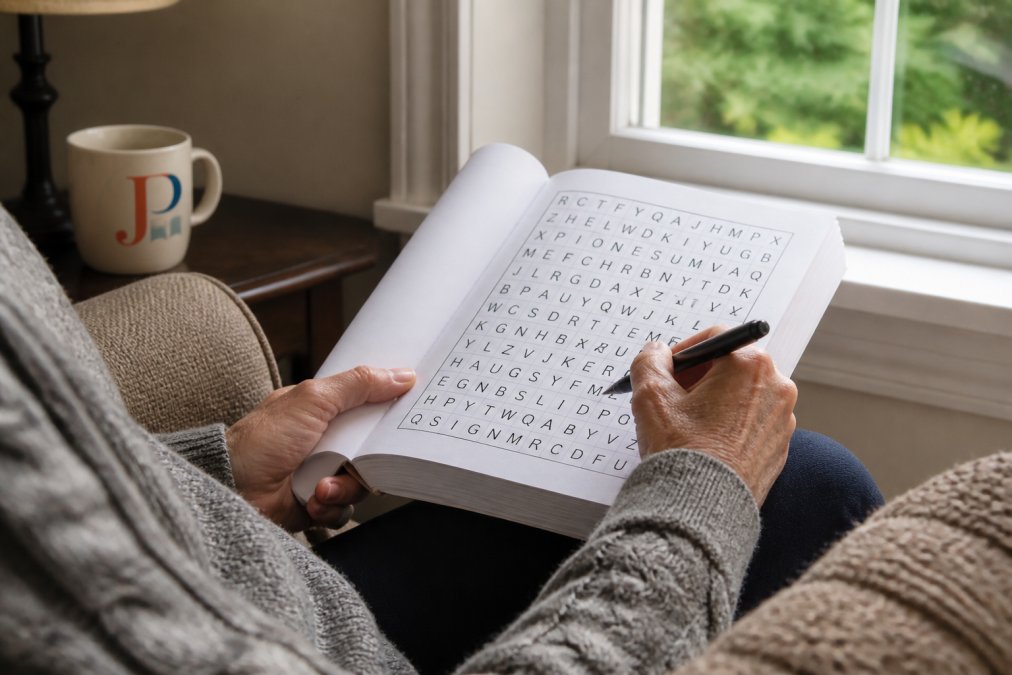
Retail data confirms the demand. Large Print is the most prominent feature among top-selling word search books for adults on major retail platforms, per Walmart's 2026 best-seller listings, with titles like large print word find collections consistently ranking at the top.
What makes large print work goes beyond point size:
- Extra-large font: 18- to 20-point type reduces eye strain
- Wider margins: Room for notes without crowding the grid
- Fewer words per puzzle: 15-20 words keeps sessions manageable
- High-contrast print: Sharp black ink on uncoated paper
Senior-friendly design is not about dumbing down puzzles. It's about removing friction so the puzzle itself stays the focus.
Benefits of Word Search Puzzles for Brain Health
Most guides in this category repeat the same four claims, sharper memory, bigger vocabulary, less stress, more mindfulness, without explaining how any of it works. That vagueness is why the claims feel interchangeable. The mechanism is more interesting than the marketing.
A word search is a sustained visual-search task. You hold a target string in working memory, scan a grid of distractors, and inhibit the urge to circle near-matches. That combination, working memory, selective attention, and response inhibition, is the same triad researchers use to describe executive function. It is also why a word search feels harder than it looks: the difficulty is not the words, it is the suppression of everything that isn't the word.
What that means in practice:
- Visual search practice: Repeated scanning trains the eye to move in efficient patterns rather than random saccades. Regular solvers tend to spot targets faster in unfamiliar grids, a pattern consistent with practice effects documented in visual-search literature.
- Working memory load: Holding a 20-word list in mind while scanning forces the brain to juggle. Shorter lists (15-20 words) keep the load in the productive range; 40-word lists tip into frustration for most adults.
- Response inhibition: Ignoring near-miss letter strings is the quiet cognitive work. It is also the part that feels tiring after 20 minutes, which is a feature, not a bug.
- Vocabulary in context: Themed lists (winter wildlife, regional foods, nautical terms) introduce words with a built-in semantic frame, which is how vocabulary sticks better than isolated word lists.
The stress-relief claim deserves the same scrutiny. The benefit is not that puzzles are relaxing in the abstract, it is that they occupy the exact attentional bandwidth rumination needs. A brain with one job has less capacity to rehearse tomorrow's worries. Ten to fifteen minutes is usually enough to interrupt a loop; longer sessions can tip into fatigue and lose the effect.
A common pattern among long-time solvers is using a single puzzle as a transition ritual, after dinner, before bed, on a commute, rather than bingeing a book in one sitting. The ritual, not the puzzle count, is what produces the reported calm.
If you want to test the effect on yourself, pick a book with 15-20 words per grid, solve one puzzle at the same time each day for two weeks, and note how you feel before and after. That is a more useful experiment than any generic claim about brain health.
How to Choose the Right Puzzle Book Difficulty
Difficulty in word search books comes down to four variables: word count, word length, direction variety, and theme familiarity. Adjusting any one of them changes how long a puzzle takes.
The best approach is to match difficulty to session length. A 10-minute solver needs different books than someone settling in for an hour.
Snowbound – Word Search Puzzle →
- Beginner: 10-15 short words, forward and down only
- Intermediate: 18-22 words, all eight directions, familiar themes
- Advanced: 25+ words, backward and diagonal heavy, obscure vocabulary
- Expert: Overlapping words, hidden messages, no word list
Difficulty progression within a single book matters too. A collection that starts easy and builds gives you a warm-up before the harder grids.
A common mistake is buying the hardest book available and losing momentum by puzzle five. Start one level below where you think you are. Finishing books builds the habit; unfinished books sit on the shelf.
Thematic Puzzle Collections and Puzzle Variety
Thematic puzzles now drive much of the category's growth. Publishers are moving beyond generic word searches toward specific themes like wildlife, nostalgia, and pop culture, according to KDP Easy's 2026 theme analysis.
Theme does more than decorate the cover. It shapes the word list, and a good word list makes the puzzle feel cohesive rather than random.
Jove Publishing's Snowbound word search book is a clear example: 50 winter puzzles covering snowy trails, frosted forests, winter wildlife, and icy landscapes, each with 20 themed words. Opposite every puzzle sits a short uplifting message, which turns a solo activity into something closer to a daily ritual.
Puzzle variety matters for a different reason. Variety books that mix word searches with Sudoku, trivia, and crosswords rank among the top all-time best-sellers in the puzzle category, per Book Bolt's 2026 KDP analysis. Rotating puzzle types keeps the brain engaged and reduces fatigue.
For readers who want more than word finds, Misty Clover Press publishes coloring books, crosswords, and mazes alongside its word search titles.
Travel-Friendly and Portable Word Search Books
Portability comes down to three numbers: trim size, page count, and weight. A book that fits in a bag without adding bulk gets used. A heavy hardcover stays home.
The standard 8.5 x 11 inch format is comfortable at a table but awkward in transit. Travel size books typically run 5 x 7 or 6 x 9 inches, which fits a tote or carry-on pocket.
What to check for a travel book:
- Trim size: 6 x 9 inches or smaller
- Weight: Under 12 ounces
- Binding: Paperback, since spiral catches on bag fabric
- Page count: 100-150 pages balances variety and bulk
For commuters, a paperback with 50 puzzles covers roughly a month of daily sessions. For longer trips, a themed collection keeps the experience from feeling repetitive.
Digital vs. Physical Puzzle Experience
Most comparisons in this category stop at "apps are convenient, books feel nice." That is true and useless. The real differences show up in how you solve, where you solve, and what your hands and eyes are doing for the 15 minutes the puzzle takes.
The tactile difference is not sentimental, it is mechanical. Circling a word with a pen is a fine-motor task: wrist stabilization, grip pressure, and a visible trace left behind. Tapping a screen is a discrete input with no trace. Solvers who switch from apps to paper often report that the paper version feels slower in a good way, the physical act of drawing a line forces a micro-pause that screen tapping skips. That pause is part of why paper sessions tend to run longer and feel more finished.
Ergonomics cut both ways. A paperback at a table lets you adjust distance and angle freely. A phone or tablet held at reading distance for 20 minutes is a neck and wrist problem, and glare in a bright room is worse on glass than on matte paper. On the other side, a tablet lets you zoom a grid to whatever size your eyes need that day, a real advantage for readers whose vision fluctuates, and one no print edition can match.
Practical trade-offs worth knowing before you buy:
- Battery and signal: A paperback works on a plane during takeoff, in a waiting room with no signal, and at the beach. An app does not.
- Cost per puzzle: A $9.99 book with 50 puzzles runs about 20 cents per puzzle and lasts a month of daily solving. A subscription puzzle app typically costs more per month than a book, but offers unlimited grids, the math favors apps only if you solve several puzzles a day.
- Interruption risk: Notifications are the single biggest difference in practice. A book cannot buzz. If your goal is screen-free leisure, this is the whole argument.
- Sharing and gifting: A finished book is a physical object you can hand to someone. A completed app level is not.
- Accessibility: Apps win for adjustable contrast, dark mode, and text-to-speech word lists. Print wins for readers who find backlit screens fatiguing in the evening.
A hybrid approach most guides ignore: use a large print paperback for daily home sessions and keep a puzzle app on your phone for travel days when space is tight. You get the tactile ritual where it matters and the portability where it counts, without pretending one format has to win.
If you are deciding between the two, run a one-week test: solve paper puzzles for three days and app puzzles for three days, and note which sessions you actually finished. Completion rate is a better signal than preference.
Comparison Table and Pricing Breakdown
Pricing in this category is refreshingly simple. Standard large print word search books start as low as $5.99, per Walmart's 2026 retail pricing, while specialized themed titles run higher.
| Format | Typical Price | Puzzles | Best For |
|---|---|---|---|
| Standard large print | $5.99-$8.99 | 50-100 | Budget daily solving |
| Themed collection | $7.95-$9.99 | 50-75 | Readers who want a cohesive theme |
| Premium spiral-bound | $10.99-$14.99 | 75-100 | Tabletop solvers, limited hand strength |
| Variety book | $8.99-$12.99 | 100+ mixed | Readers who rotate puzzle types |
Themed titles like Penny Dell's 'America at 250' sit at $7.95, per Penny Dell Puzzles' 2026 direct pricing, which shows the ceiling for a well-produced single-theme book.
Jove Publishing's Snowbound word search sits at $9.99 for 50 puzzles, 119 pages, and a message page paired with every grid. That price reflects the paper quality, the full-page layout, and the themed construction rather than just puzzle count.
The value question is not price per puzzle. It's price per finished puzzle. A $6 book you abandon after five grids costs more per solved puzzle than a $10 book you complete.
Conclusion: Finding Your Next Word Search Book
The best word search books for adults share four traits: readable type, paper that handles pen ink, binding that suits your solving spot, and a theme or difficulty level that keeps you coming back.
Jove Publishing builds books around those priorities. Snowbound pairs 50 winter-themed puzzles with 50 uplifting messages, printed at a comfortable size with 20 words per grid and a full page for every puzzle. Readers looking for broader variety can explore the Misty Clover Press catalog of word searches, crosswords, mazes, and coloring books, or browse Jove Publishing's paperback bundles for a gift-ready set.
Get started with Jove Publishing and find the puzzle book that fits your routine.
Frequently Asked Questions
What are the best word search puzzles for adults?
The best word search books for adults match your goals: large print for readability, spiral binding for flat use, and themes you enjoy. Look for 50 or more puzzles per book, clear fonts, and quality paper that resists bleed-through. Titles like Snowbound offer 50 winter-themed puzzles with 20 words each, providing hours of screen-free entertainment. According to KDP Builder (2026), word search books hold the largest total demand among puzzle niches on Amazon KDP.
Are word searches good for your brain for adults?
Yes. Word searches provide cognitive stimulation that supports mental acuity, vocabulary building, and focus. The focused attention required activates multiple brain regions, similar to other brain games. Studies show that large print puzzle books are a primary leisure staple for readers aged 50 and older, offering cognitive health benefits. For adults of any age, regular word search practice can be a mindful leisure activity that supports overall brain training.
What is a good word search book for elderly people?
Large print word search books are ideal for elderly readers. Look for fonts of 16 points or larger, high-contrast paper, and lightweight paperback or spiral-bound formats. Books with 50 to 100 puzzles and solution keys provide ongoing entertainment. Snowbound is a large print option with 50 winter puzzles and 50 uplifting messages, designed for relaxation and focus. As noted by Crises Notes (2026), large print find-a-word books help redefine leisure for older adults.
Do word search books help with stress relief?
Word search books can help with stress relief and anxiety management by providing a structured, screen-free leisure activity. The repetitive, focused task encourages mindfulness, similar to meditation, by redirecting attention from worries. Many adults in their 30s use physical puzzle books as a digital detox to reduce phone usage (Reddit, 2026). Pairing a word search with a warm drink and a comfortable spot can enhance the calming effect.